
Search Indiana Warrant Records
Indiana warrant records are official court documents that authorize law enforcement to arrest an individual or take other legal action. These records exist in each of Indiana's 92 counties and are open to the public through several state and local systems. The Indiana court system uses the Odyssey platform to manage cases statewide, and that data feeds into the free MyCase portal. You can search Indiana warrant records online through the court system, contact your county sheriff's office, or visit a county clerk in person. This page links to the main tools and offices that handle warrant records across Indiana.
Indiana Warrant Records Quick Facts
Indiana Warrant Records on MyCase
MyCase is Indiana's main online court portal for finding warrant records and case information. The Indiana Office of Judicial Administration runs it at public.courts.in.gov/mycase. Most courts across Indiana use the Odyssey Case Management System from Tyler Technologies, and case data flows directly into MyCase. You can search by case number, party name, or attorney name. The system supports wildcard searches using an asterisk and Soundex searching for names that sound alike. All public cases, those not sealed, expunged, or marked confidential, are searchable here. Anyone can use MyCase for free with no account required. Criminal cases, civil cases, family court, traffic matters, and appellate filings are all in the system.
The Office of Judicial Administration notes that information on the site is "made available as a public service pursuant to order of the Indiana Supreme Court." Results from MyCase are not official court records and may contain errors or omissions. For verified or certified copies, you must contact the clerk's office at the court where the case is filed. Some older cases do not have all documents available in the portal, and Indiana courts direct users to local clerks for those files. MyCase also provides access to the chronological case summary, or CCS, along with financial data such as amounts owed and payments on criminal cases.
Indiana's MyCase portal is the state's primary tool for searching warrant records across most counties. The Indiana Office of Judicial Administration maintains the system.
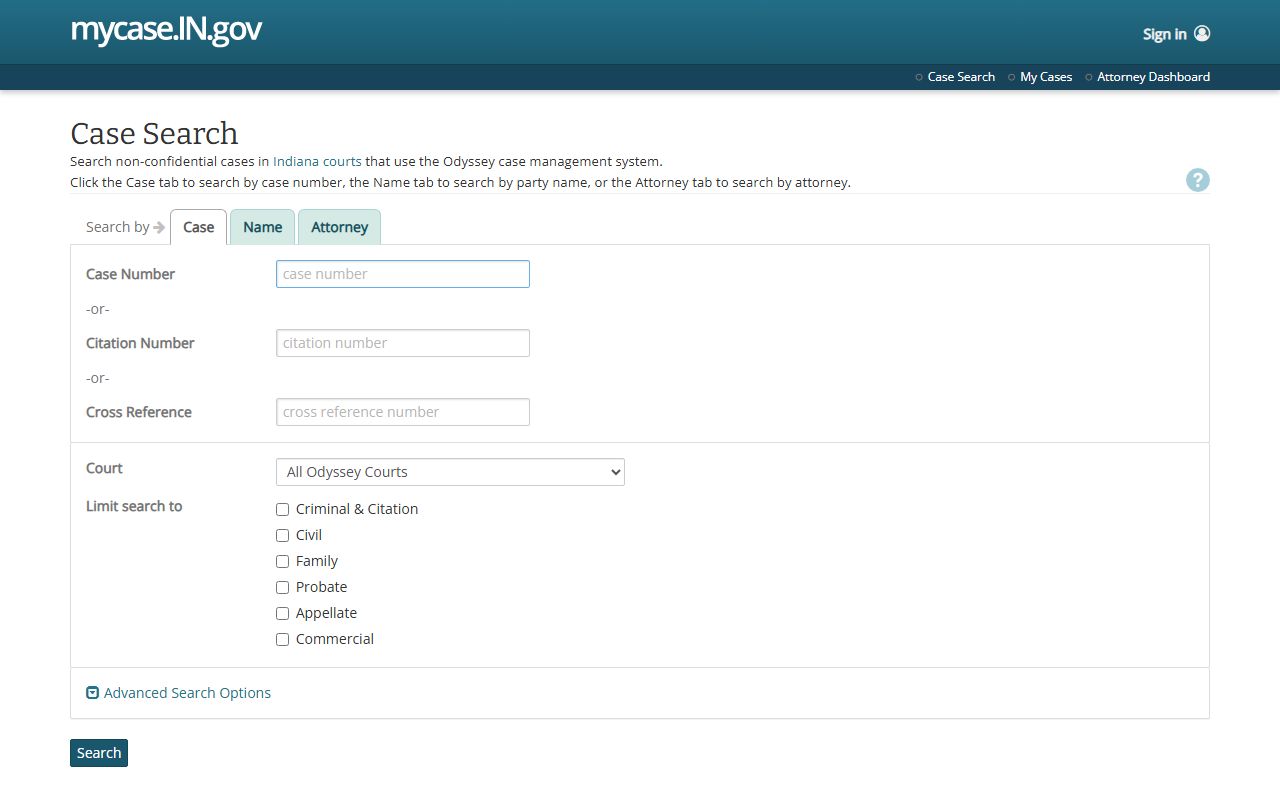
Search results from MyCase are informational only and are not a substitute for official court records from the clerk's office.
Indiana State Police Warrant and Criminal History Records
The Indiana State Police Records Division provides a Limited Criminal History search at in.gov/isp/criminal-history-services. This tool is separate from MyCase and focuses on felony and Class A misdemeanor arrest records within Indiana. It searches by name, date of birth, race, and gender. You can also add a Social Security Number or place of birth to narrow down results. The ISP updated and improved this system in recent years to include more data fields for more accurate and conclusive results. Results fall into one of three categories: ON FILE, INCONCLUSIVE RESULTS, or NO RECORDS FOUND. Under IC 10-13-3-11, a limited criminal history must include a disposition and a photograph of the person when available. The report covers Indiana records only and does not include history from other states. The mail-in address is Indiana State Police, Criminal History Limited Check, P.O. Box 6188, Indianapolis, IN 46206-6188. The ISP Records Division phone is 317-232-8262.
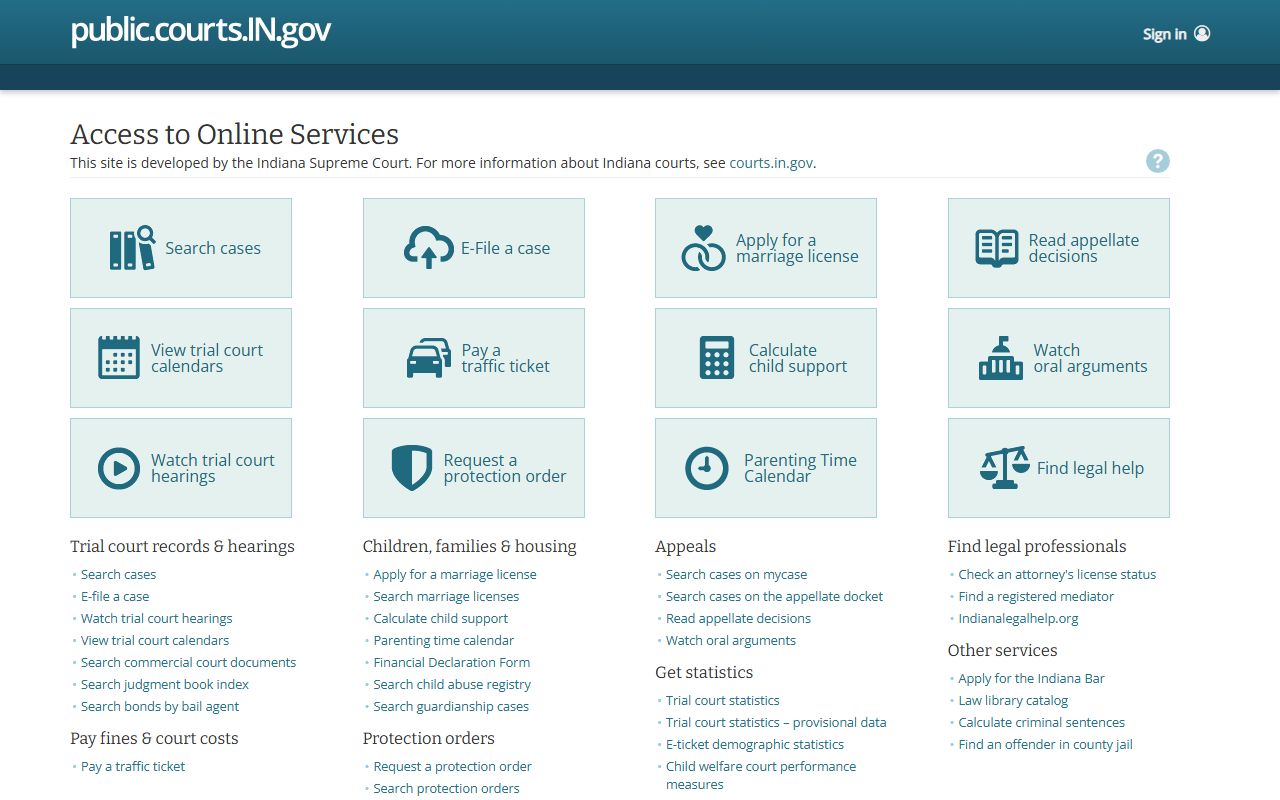
Indiana's court public records portal at in.gov/courts/public-records connects users to MyCase, the tax warrant system, protection order registry, and other official tools for finding warrant records and court information.
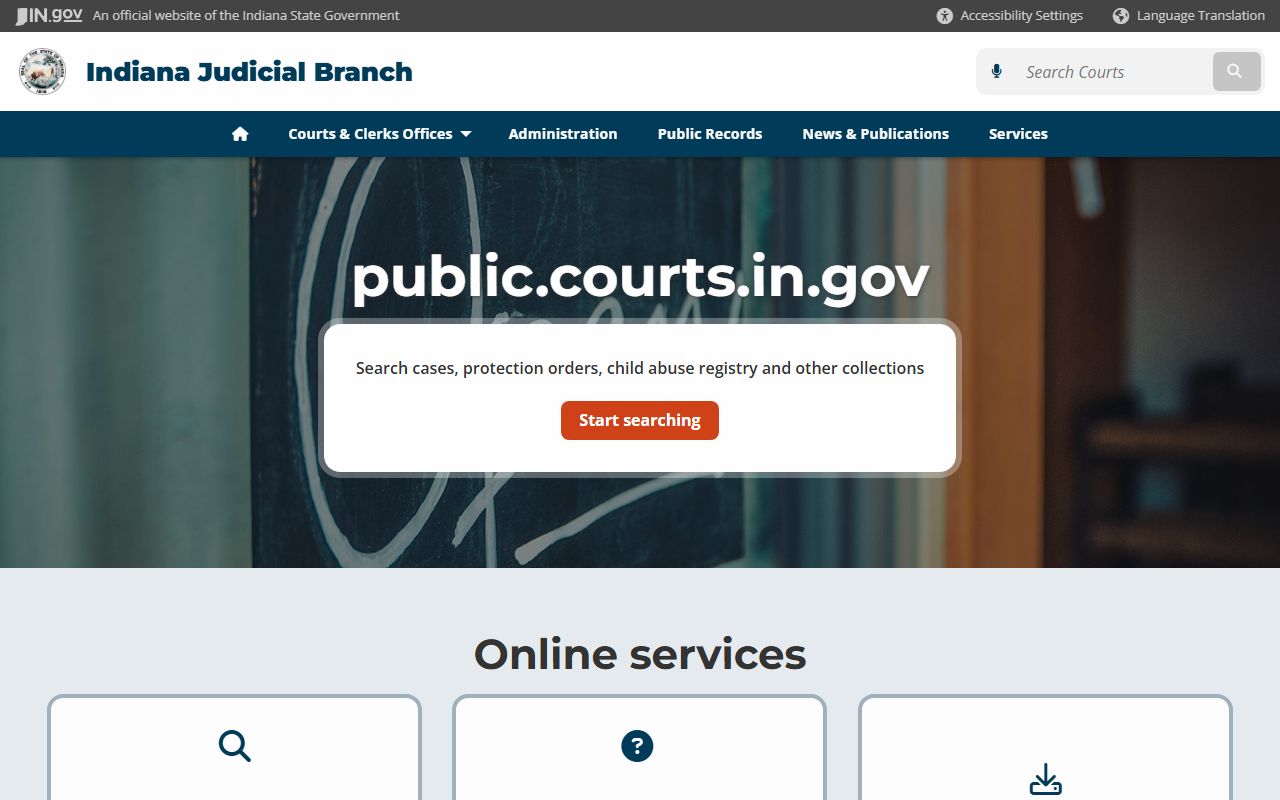
Records through these state portals reflect Indiana-only information. A full FBI fingerprint check through a licensed provider is needed for out-of-state history.
All searches through the online ISP service count as completed requests and carry fees, whether or not a record is found. PDF results expire 14 days after the search is done, so have a printer ready at the time of request. Online searches cost $15.00 per record for subscribers and $15.70 per record by credit card.
Indiana Tax Warrant Records
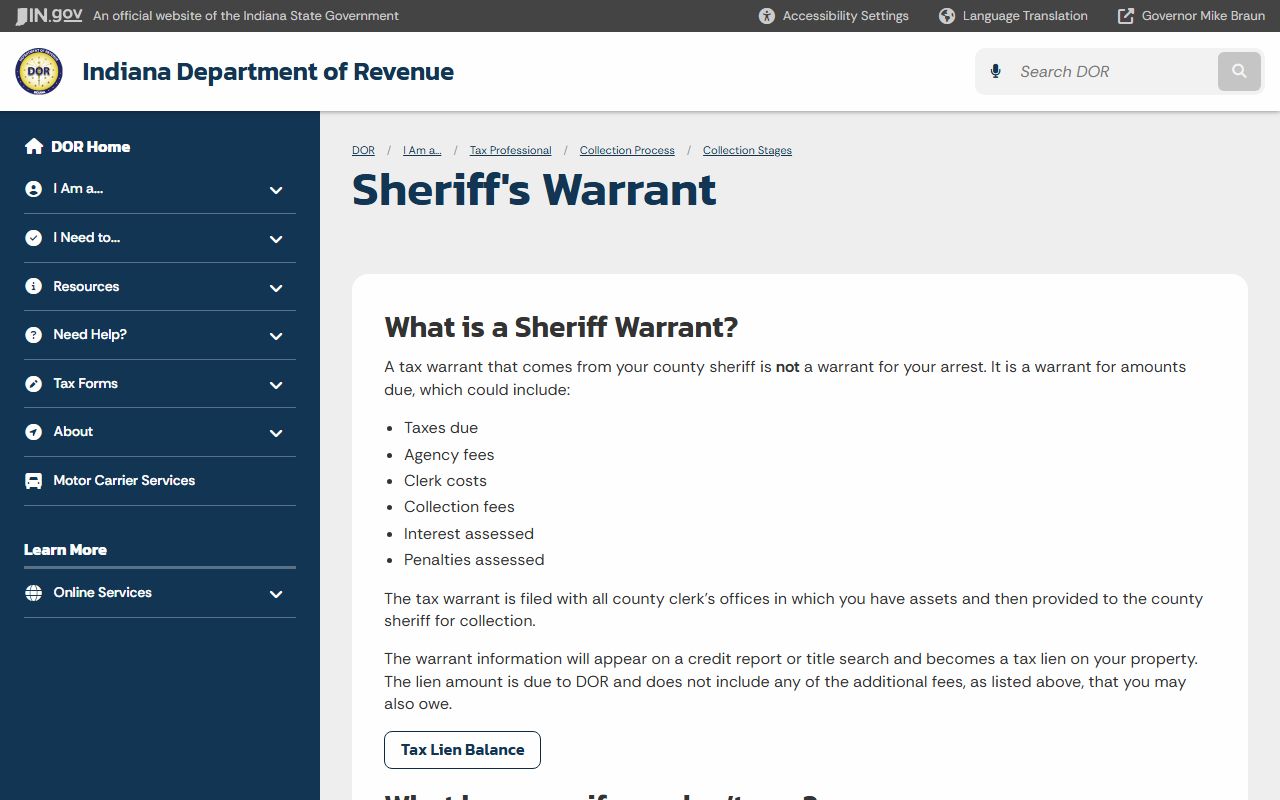
Indiana separates tax warrants from criminal arrest warrants. The Department of Revenue, or DOR, issues tax warrants when a business or individual owes unpaid state taxes. The DOR files these warrants with county clerks across Indiana and then sends them to the county sheriff for collection. A tax warrant creates a lien on property and shows up on credit reports and title searches. Amounts covered can include back taxes, agency fees, clerk costs, collection fees, interest, and assessed penalties. The DOR is direct about this distinction: a tax warrant from your county sheriff is not a warrant for your arrest. It is a warrant for amounts owed.
The Indiana Department of Revenue's sheriff warrant page explains how tax warrants work and what they cover under Indiana collection rules.
To resolve a tax warrant, pay the county sheriff directly, set up a payment plan for up to one year, or use Indiana's INTIME tax portal at intime.dor.in.gov. Mail payments go to Indiana Department of Revenue, PO Box 595, Indianapolis, IN 46206-0595. Call DOR at 317-232-2165 with questions about a specific open tax warrant.
Indiana also runs an electronic system called e-Tax Warrant. The Office of Court Technology and the DOR built this together. It lets clerks process tax warrants digitally and makes them searchable online. The e-Tax Warrant search covers 79 Indiana counties. The INcite platform creates an electronic Judgment Book record for each filing, so warrants appear in the system right away. Satisfactions are processed immediately when received. Questions about the e-Tax Warrant system go to 317-233-7640 or toll free at 888-275-5822.
Indiana Protection Order Registry
Indiana's Protection Order Registry connects courts that issue protection and no-contact orders to law enforcement databases statewide. When a court issues an order, the registry enters it into the Indiana Data and Communication System, or IDACS, and the FBI's National Crime Information Center, known as NCIC, within minutes. The Indiana Supreme Court, the Criminal Justice Institute, and the State Police jointly run this system. Law enforcement can confirm whether a valid protection order exists in real time from any computer. The public search tool is at public.courts.in.gov/por. You can search by cause number or by the respondent or defendant name. Orders can also be printed with a Spanish translation directly from the system.
The Indiana Protection Order Registry at public.courts.in.gov/por allows courts, law enforcement, and the public to look up active protection and no-contact orders statewide.
These records do not appear in MyCase. Federal law requires protection order information to stay restricted from the general public court database.
When a court issues an order, the registry notifies the petitioner when it is issued, when it has been served, and when it is approaching expiration at the 60-day mark. Notifications go out by fax or email to local law enforcement in the areas where both parties live and work. This keeps protection orders active across county and state lines. Contact Carl Cowan at 317-234-5994 or carl.cowan@courts.in.gov with registry questions.
Indiana County Sheriffs and Warrant Records
Each of Indiana's 92 county sheriffs maintains warrant records for their county. Arrest warrants, bench warrants, and probation warrants all flow through the sheriff's office after a court issues them. Some counties post active warrant lists online that anyone can search by name, offense type, or date. Allen County runs a dedicated Warrants and Fugitive Division at 715 S. Calhoun Street in Fort Wayne. That division keeps records of adult criminal bench warrants, adult probation warrants, parole warrants, family court warrants, and small claims body attachments. It also handles all extraditions, including court hearings and transport. Their warrant tip hotline is (260) 449-3343, and Crime Stoppers is (260) 436-7867. As of late 2025, Allen County had more than 7,000 active warrants in the statewide computer system. The warrants page at allencountysheriff.org/warrants is one of the most detailed active warrant resources in Indiana. Their site also includes an inmate search tool for checking current jail status.
Indiana's official sheriffs directory at in.gov/sheriffs provides a map-based list of all 92 county sheriff offices with contact links and phone numbers for every county in the state.
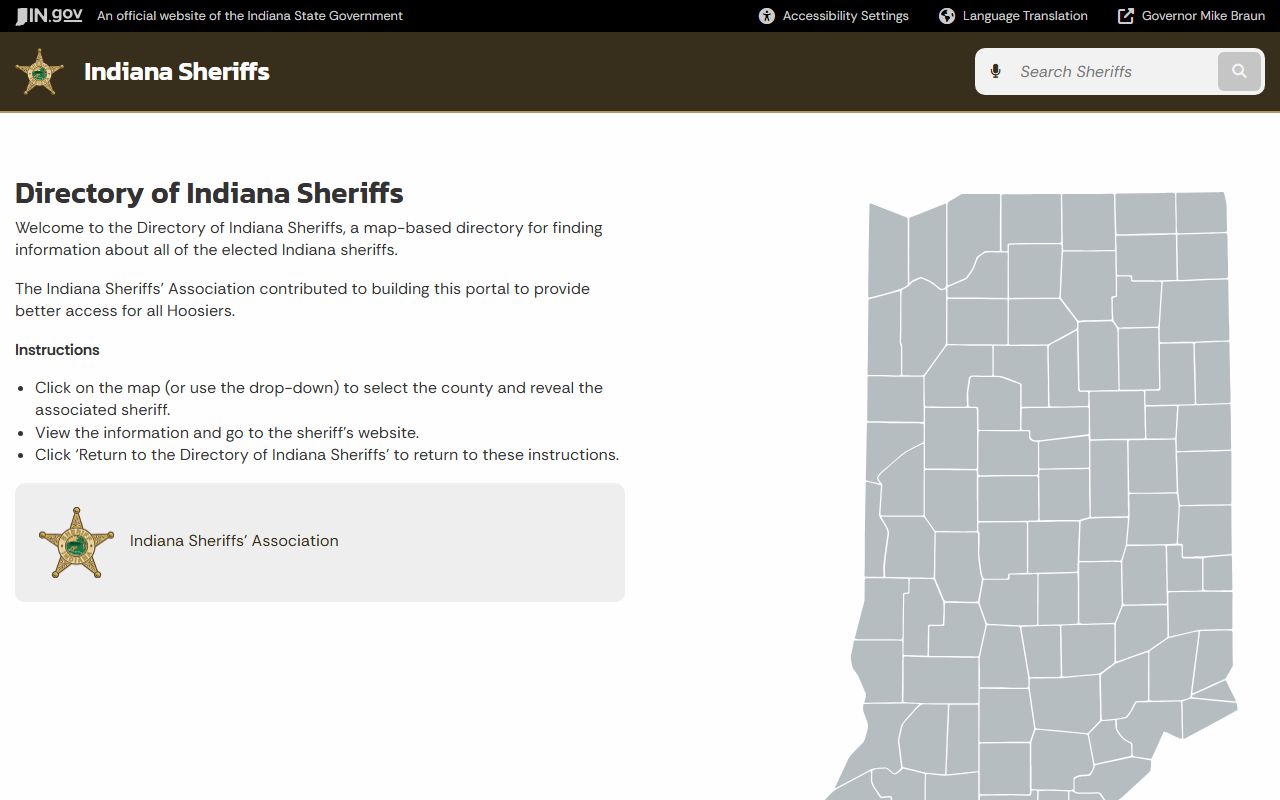
Click a county on the map or use the drop-down menu to navigate directly to any county sheriff in Indiana.
Vanderburgh County offers an active warrant search at vanderburghsheriff.org/warrant-search. You can filter by name, date range, and warrant type, including felony, misdemeanor, or child support writ. Madison County has a searchable active warrant list at sheriffofmadisoncounty.com/warrants, though updates can run up to 23 hours behind. Jackson County runs a 24-hour main line at (812) 358-2141. Harrison County provides warrant status checks around the clock, seven days a week. Noble County's site at noblecountysheriff.org links to The Most Wanted Online Warrants Network for searching outstanding criminal warrants across Indiana. La Porte County's sheriff references MyCase directly on their public records page for Indiana court and case information.
The Indiana Sheriffs' Association at indianasheriffs.org works as a coordinating body for all 92 county sheriff departments and provides a directory for reaching any county office in the state.

The association's office is at 7124 E County Rd 150 S, Suite B, Avon, IN 46123. You can reach them at (317) 356-3633 or toll free at (800) 622-4779.
How Indiana Warrant Records Work
Indiana law is specific about how courts issue warrants and what those warrants must contain. Under IC 35-33-2-1, a court can issue an arrest warrant after an indictment is filed, or after a judge finds probable cause that a person committed a crime and an information has been filed. When an information is used, the court must make the probable cause determination before issuing the warrant. This protects individuals from arrest without proper legal process. A formal filing in court must come first before any warrant can go out.
IC 35-33-2-2 lists all required elements of an Indiana arrest warrant. It must be in writing, name or describe the person to be arrested, state the nature of the offense, show the date and county of issuance, carry the signature of the clerk or judge with their title, command the person be brought before the court without unnecessary delay, note any bail amount, and be directed to the county sheriff. Courts cannot issue a warrant that skips any of these requirements. This structure ensures that every warrant issued in Indiana is legally complete and enforceable by any sheriff in the state.
Not all warrants stay active forever. Under IC 35-33-2-4, a misdemeanor arrest warrant expires 180 days after it is issued. Felony warrants and rearrest warrants do not expire. When a misdemeanor warrant expires, the sheriff must return it to the clerk with a note that it has lapsed. The clerk records this and notifies the prosecuting attorney, who can ask the court to issue a new warrant. This matters when searching older records, because a database may show a misdemeanor warrant that is no longer valid. Checking current status through MyCase or your county sheriff confirms whether any warrant is still active.
Indiana's Access to Public Records Act, at IC 5-14-3, makes executed warrants part of the public record. Unserved warrants that a judge has ordered sealed stay confidential until they are served.
The MyCase help center at in.gov/courts/help answers common questions about searching for warrant records, accessing case documents, and understanding what the portal covers.
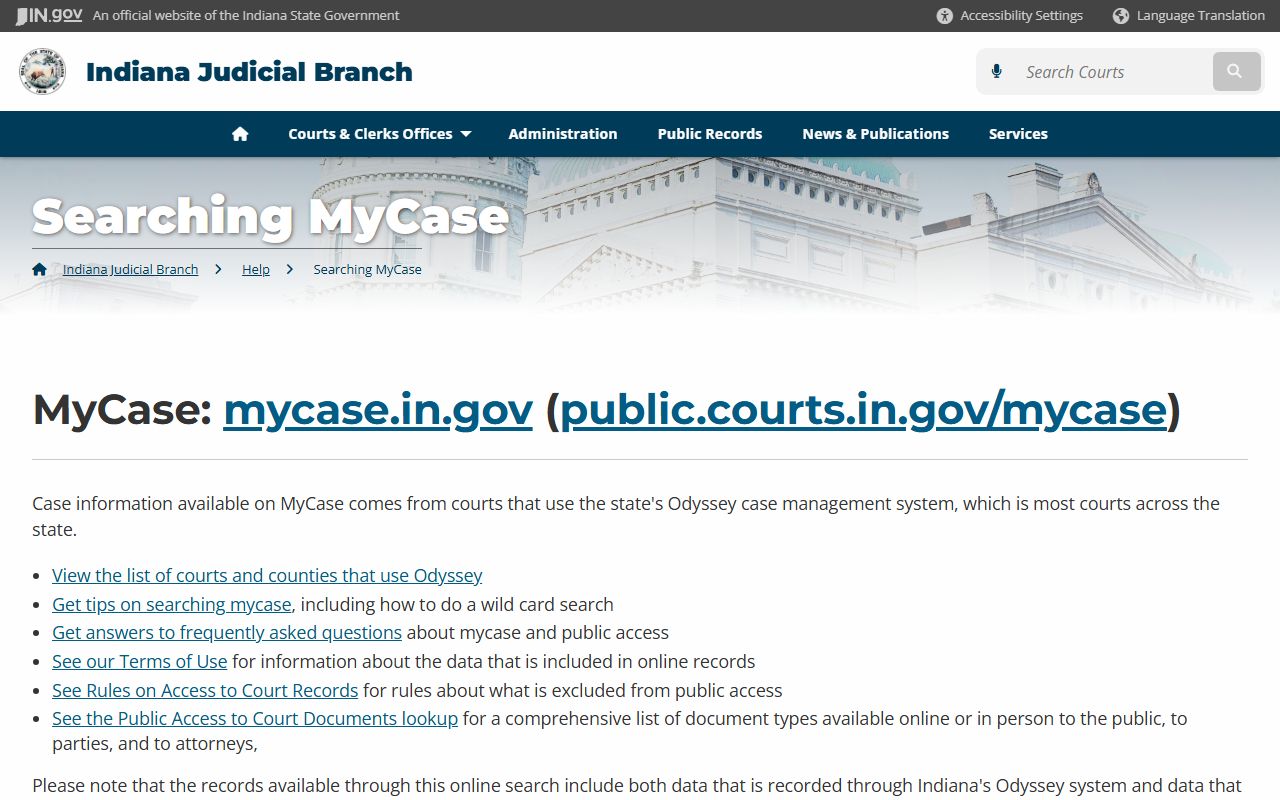
Note: The help center includes specific guidance on how to find out whether a court has issued a warrant for a person's arrest in Indiana.
Browse Indiana Warrant Records by County
Warrant records in Indiana are maintained at the county level. Each of the 92 counties has a sheriff's office with active warrant records and a clerk's office with full court case files. Pick a county below to find local warrant resources, sheriff contact information, and court search tools for that area.
Warrant Records in Major Indiana Cities
Residents of Indiana's major cities file court cases through the county that surrounds them. Pick a city below to find warrant records resources and local law enforcement contact information for that area.